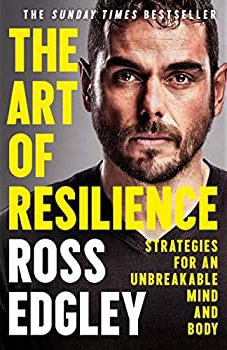
THE ART OF RESILIENCE
ROSS EDGLEY
From running a marathon whilst pulling a 1.4-ton car, swimming 100 km between two Caribbean islands while towing a tree, and climbing the height of Everest on a rope, Ross Edgley pushes the limits of endurance and strength.
In 2018 Ross spent 5 months at sea, becoming the first person to swim around the island of Great Britain. Battling stinging jellyfish, whirlpools, storms, rhino neck, and sea ulcers, Ross Edgley, through tremendous determination, grit and strength, somehow managed to complete what became known as The Great British Swim.
Swimming 12 hours a day, it took him 157 days to swim the 1,791 miles (nearly 3,000 kilometers), without touching land the entire time.
Lesson 01 | Days at sea: 1
Stoic sport science is philosophy forged in battle
Stoicism teaches us that virtue is happiness and judgement is based on behaviour rather than words. We don't control external events, only ourselves and our responses.
Lesson 02 | Days at sea: 4
learn the power of spiritual sport science
For centuries, we humans have been using extreme acts of self-discipline (in the form of a pilgrimage or an Okugake) to learn more about ourselves as a form of self-discovery.
Lesson 03 | Days at sea: 12
the body bruises AND BLEEDS BUT CANNOT BE BEATEN
Sometimes the best athletes aren't the strongest, fastest or fittest, but they are the most endurig to pain (something the Kalenjin tribe have known for centuries).
Lesson 04 | Days at sea: 24
TO WALK YOUR OWN PATH, WRITE YOUR OWN PLAN
In 1875, Captain Matthew Webb became the first person to swim the English Channel, a feat many believed was impossible, which is why he had to write his own training programme. Remember: there is no blueprint when attempting the impossible. You must create your own.
Lesson 05 | Days at sea: 31
MAKE THE BODY AN INSTRUMENT, NOT AN ORNAMENT
Learn to make your body an instrument, not an ornament. This closely related to the SAID principle, "Specific Adaptation to imposed Demands'', which (put simply) means your body adapts specifically to the demands you place on it and that you get really, really good at what you repeatedly practice.
Lesson 06 | Days at sea: 36
BUILD RESILIENCE BY 'GETTING WINTERED'
It was Epictetus who famously said, ''We must undergo a hard winter training and not rush into things for which we haven't prepared.'' This is because so often wars were not fought in the winter in ancient Greece; there the time should be spent training and preparing for the battles that might come in spring.
Lesson 07 | Days at sea: 44
FAST CAN BE FRAGILE AND SLOW CAN BE STRONG
The concept of periodisation and training for many months (even years) before an event - in a cycle of prepare, compete, relax, recover and repeat - enables athletes to perform at their best when it really matters. From the early years of the ancient Olympics through to the modern Games, athletes who develop develop strategies for peaking at the right time give themselves the best chance of success.
Lesson 08 | Days at sea: 50
STRENGTH IMPROVES STAMINA AND STAMINA IMPROVES STRENGTH
Strength training can improve your stamina. If you concurrently train your fast-twitch and slow-twitch muscle fibers, your endurance performance will benefit.
Lesson 09 | Days at sea: 59
learn HOW TO CRUISE OR KILL
There is no universally agreed consensus on the best way to train for endurance. But one method that's proved highly succesful over years is the 80/20 polarised training approach.
Lesson 10 | Days at sea: 79
learn to limit limitations
Based on the teachings of the psychobiological model of fatigue, fatigue is a central brain perception, based on the sum of the sensory feedback from the legs, lungs and heart which triggers our brain to slow us down and prevent us from reaching complete exhaustion and hurting ourselves.
Lesson 11 | Days at sea: 80
the two ways to process pain
Adaptive coping strategies (adjusting to the environment or situation) can help to restore a sense of self-control over pain.
Lesson 12 | Days at sea: 81
combat fear with 'feral fear theory'
As humans we still tend to process fear in a very animalistic, primitive way. We need to manage our internal operating system by understanding the concept of feral fear.
Lesson 13 | Days at sea: 83
learn the power of higher purpose
Medical science shows us that psychological healt is predicated on fulfilling innate human needs in priority known as Maslow's Hierarchy of Needs.
Lesson 14 | Days at sea: 90
accept the uncontrollables
When you are stressed by an external force, it's not the force itself that troubles you, but only your judgement of it. Once you understand this, you can learn to Accept the Uncontrollables and practice the Art of Acquiescence to achieve your goal.
Lesson 15 | Days at sea: 103
control the controllables
The ancient stoics believed we might become physically vulnerable and are often at the mercy of external events that are outside of our control (the Uncontrollables), but that our inner domain (the Controllables) cannot be conquered without our consent.
Lesson 16 | Days at sea: 122
resilience cannot be rushed, but quitting can
Keeping the heart rate at a sustainable level is essential for optimum performance in endurance events (Impeccable Pacing). If the heart rate is too high (or too low) this encourages the brain to send a signal to our bodies to shut down.
Lesson 17 | Days at sea: 134
you're stronger when smiling
The Royal Marines practice a philosophy of Cheerfulness in the face of adversity. This is supported by the research that shows that performance levels increase and perceived exhaustion levels are delayed when the brain is primed with positive subliminal visual cues (''happy'' pictures or words absorbed by the brain only at the subconscious level).
Lesson 18 | Days at sea: 138
you can sleep yourself stronger
To keep your circardian rhythm (hormones and basic bodily functions) running like clockwork, your body relies on zeitgebers (external and environmental clues such as mealtimes and natural light and darkness). Ignore these at your peril.
Lesson 19 | Days at sea: 142
heroics in hunger
Do not eat according to rules, regulations ad checklists, since according to research: ''There would have been no single universal diet consumed by all extinct hominin species. Rather, diets would have varied by geographic locale, climate and specific ecologic niche.''
Lesson 20 | Days at sea: 143
resilience is best served with food
The Great British Swim diet involved eating between 10,000 to 15,000 calories per day and a dual-fuel approach of plentiful supplies of carbohydrates and proteins.
Lesson 21 | Days at sea: 153
stomach of steel
The gastronointestinal tract plays a critical role in delivering carbohydrates and fluid during prolonged exercise. A stomach of steel can therefore be a major determinant of performance.
Lesson 22 | Days at sea: 157
resilience is suffering strategically managed
Some statistics from the Great British Swim:
- 157 days at sea
- 0 Sick days
- 649 bananas eaten
- Over 1 million calories consumed
- Over 100 jellyfish stings
almost there...
Leaving a legacy
What lesson can we learn from this? That anything is possible!